It is perfectly natural for a couple who is emotionally connected to a farm – in this case, in a village named Pamhagen, in the heart of the Neusiedler See National Park, in eastern Austria, a UNESCO world heritage site – to wish the property to be kept in the family for posterity, i.e., that the inner spell of the land reaches at least one of their three sons. Well, it seems that in this case Gaia has heard their prayers, and not one but the three sons (Werner, Hannes, and Lukas) ended up being placed under the spell and are now a crucial part of the project Meinklang.
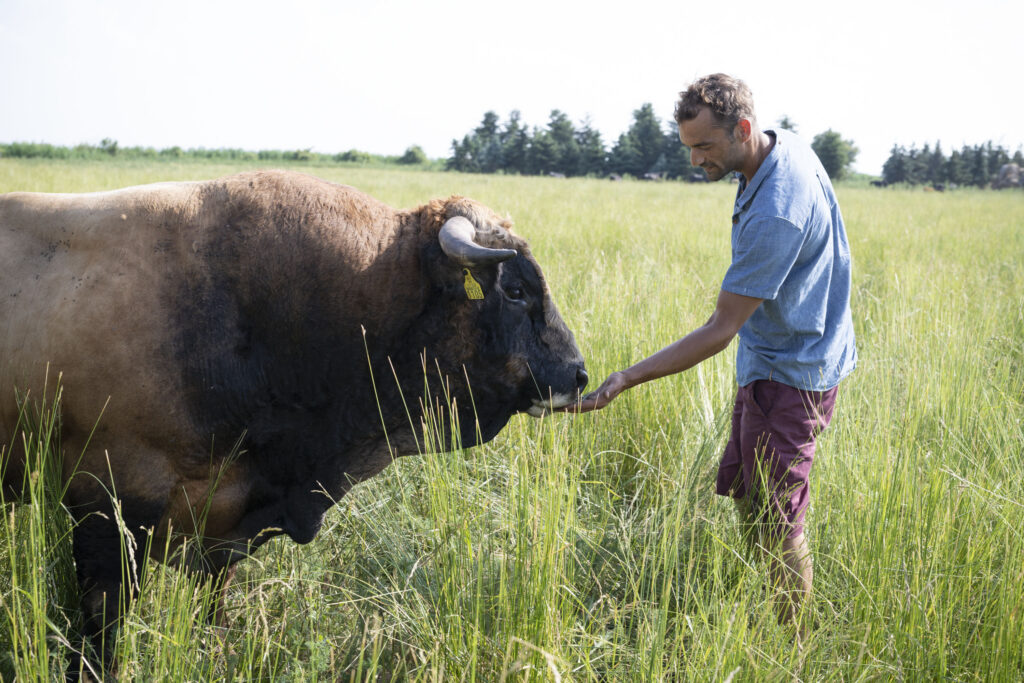
Later there was the obvious necessity to expand the farm, and, since Pamhagen is located very close to the border with Hungary, the property now encompasses land in both countries, having increased its area from 40 to 2,300 hectares. This expansion of the farming area did not change, however, the main foundation of Meinklang – biodynamics, in opposition to the concept of “monoculture,” makes the farm a living organism, in which farm animals and wild plants cohabit in intimate association with the culture of spelt, oat, rye, barley, millet, buckwheat, farro, and einkorn wheat. Local herds of cows, horses, pigs, sheep, goats, and chicken provide natural manure used to produce compost to fertilize the vineyards and the rest of the farm. This kind of environment in German has a very specific name, “Wein-Garten,” something like a garden of vines.
Nowadays, Meinklang is run by Angela and Werner Michlits, with Niklas Peltzer, who joined the family in 2014 with the task to spread the energy and the diversity of this beautiful farm to the outside world. Their goal is to re-connect the producer with the consumer, to let the world know that there is a human force behind the wine. The winemaking decisions are taking together by the trio, and as proof of the diversity of the farm they recently employed a chef to make flour and open a farm shop in Vienna.
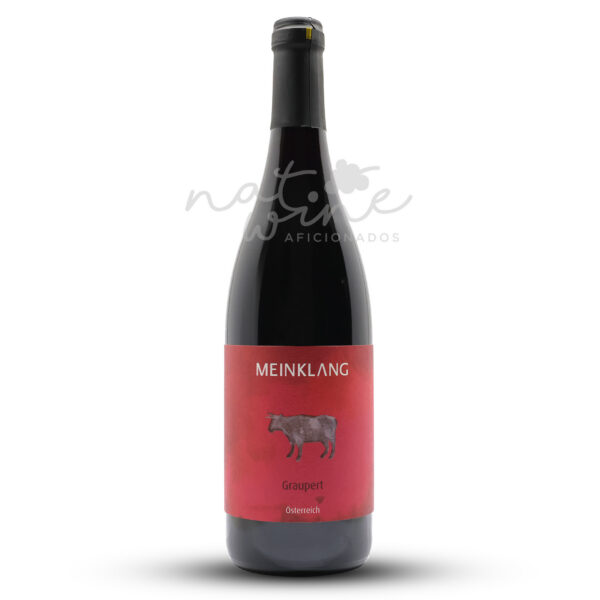
One example of the circularity and self-sufficiency of this ecosystem is the way Grauburgunder (a.k.a. Pinot Gris) vines are worked, since they are not pruned, and so they are totally free to grow in accordance with their own spontaneous metabolism and elementary inclinations. By not being disturbed, the grapes administer their own yields – the small ripened berries have a higher skin-to-pulp ratio – and so they also provide more aroma, hue, and complexity in the wine. This utterly disordered vineyard is known as “Graupert,” a term from the Burgenland dialect used in the former times to describe someone with a shabby appearance.
In German “mein” means “my,” and “klang” may be translated by “sound.” MY SOUND is the sound of insects, birds, vegetables, fruits, the fertility and the self-sustained character of the land, and the mooing of the cows at daybreak. The sound of (my) wine.